Is water leaking when no one is using it?
Most hidden leaks give no sign until the bill arrives or a ceiling stain appears. The water meter is the quickest way to know. If it moves when every tap and appliance in the house is off, water is going somewhere. That test costs nothing and takes ten minutes.
This guide walks you through the test, explains what the result means and shows how a plumber finds the leak without tearing out walls. Our leak detection page covers the service itself.
The ten-minute meter test
- Stop all water useTurn off every tap, the dishwasher, the washing machine and the ice maker. Make sure no one flushes.
- Find the meterIt is usually in the basement near the main shutoff, or in a pit outside.
- Read the dialNote the position of the small leak indicator, a triangle or a small wheel, and the number.
- Wait ten minutesDo not use water during this time.
- Read it againIf the indicator moved or the number changed, you have a leak.
A moving meter does not tell you where. It only tells you that the leak is real.
Narrowing down where the leak is
Close the main shutoff. If the meter stops moving once the valve is closed, the leak is inside the house. If it keeps moving, the leak is between the meter and the valve. If the meter does not move at all with the valve open and nothing running, the leak is gone or intermittent.
The usual suspects are a running toilet, a dripping hot water line, a failing water heater relief valve and a pipe in a wall or under the floor. A toilet is the most common. Add a few drops of food coloring to the tank. If color reaches the bowl without flushing, the flapper leaks.
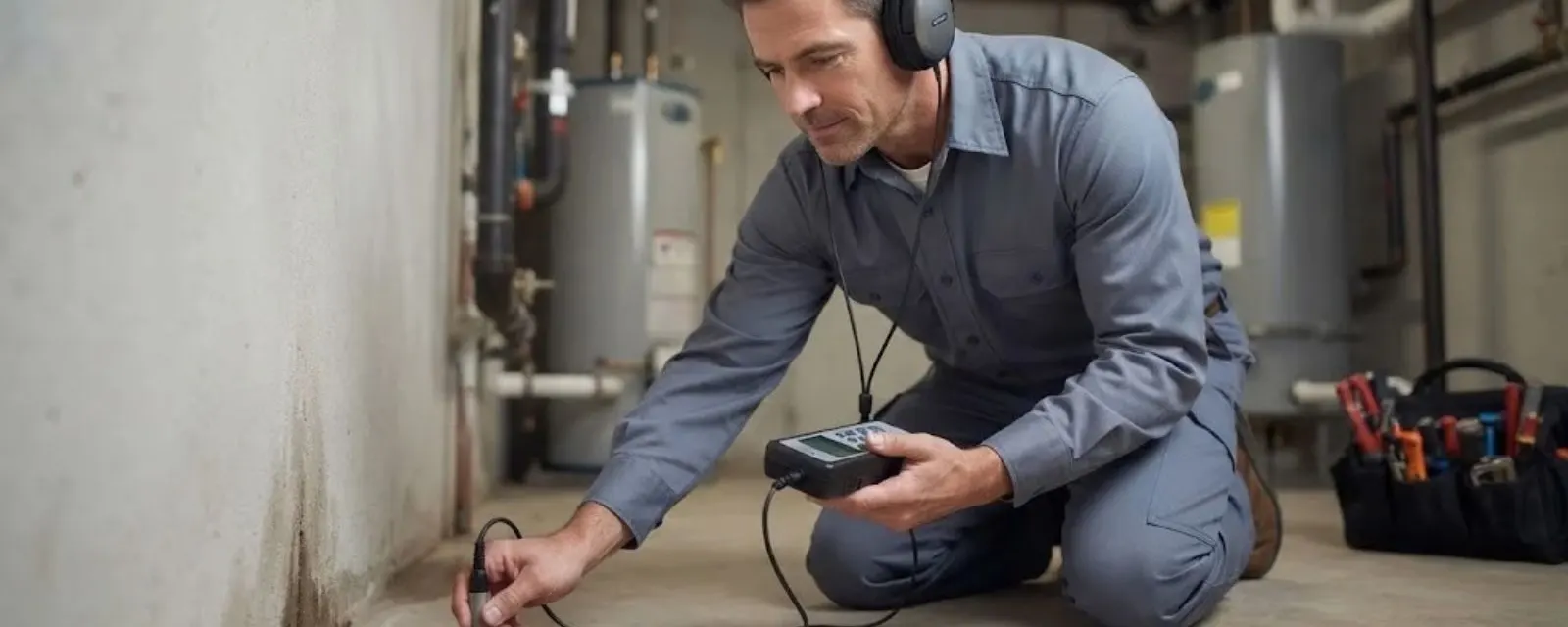
How a plumber finds the leak
| Tool | What it finds |
|---|---|
| Acoustic listening device | Sound of water escaping a pressurized pipe |
| Thermal camera | Warm or cold lines behind a wall |
| Pressure test | Which branch of the system is leaking |
| Moisture meter | Damp areas in drywall or floors |
These tools let us open a small section instead of a whole wall. After the leak is found we price the repair before we start.
Water running somewhere it should not?
Close the main and call the 24/7 line.
What happens after the leak is found
- Small fitting leak: tighten or replace the fitting.
- Pinhole in copper: cut out and sleeve the section.
- Failed supply line: replace the line.
- Widespread pinholes: consider repiping.
If a pipe has already burst, shut the main and go to our burst pipe repair page.
Common places where leaks hide
| Location | Typical cause | Clue |
|---|---|---|
| Behind a toilet | Worn flapper or fill valve | Toilet runs or refills on its own |
| Under a sink | Loose supply or drain connection | Damp cabinet floor or musty smell |
| Water heater area | Failed relief valve or tank leak | Puddle or rust at the base |
| Wall or ceiling | Pinhole in a pipe | Stain, bubbling paint or warm spot |
| Outdoor spigot | Cracked pipe after freezing | Wet ground or drip when on |
| Under the slab | Corroded supply line | Warm floor spot, constant meter movement |
Why a small leak costs more than you expect
A faucet that drips once a second wastes several gallons a day. A toilet that leaks silently can waste far more. Over a billing period that adds up to a noticeable bill, and the water also damages wood, drywall and insulation. Mold follows a persistent wet spot within days in a warm, closed space.
Fixing a small leak early costs a fraction of the repair after the damage spreads. If the meter test says water is moving, act on it.
What to do if you find the leak
- Shut off the nearest fixture valve, or the main if you cannot find it.
- Photograph the damage for your records and for your insurer.
- Dry wet materials quickly with fans and a dehumidifier.
- Call a plumber before opening walls, so the leak is located first.
- Ask your water district about billing adjustments after a documented leak.
Districts differ on whether they adjust a bill after a repaired leak, so ask yours rather than assuming.
Local notes for Chelmsford homes
Chelmsford has three separate water systems, the Chelmsford Water District, the North Chelmsford Water District and the East Chelmsford Water District. Call the district that bills you about the meter itself, billing questions and anything on the street side. A leak on your side of the meter is yours to fix, and we can find it.
Do not guess about a high bill. Ask your district whether it reads the meter automatically and how often. A bill that doubles with no change in use is a good reason to run the test above. For help in nearby towns see Westford and Lowell.
Water suppliers are required to publish an annual water quality report under the federal Safe Drinking Water Act, and your district can explain its metering and billing guidelines.
Questions Chelmsford homeowners ask
It may be. Run the meter test. A moving meter with everything off means water is escaping.
In many homes it is in the basement near where the main enters. Some are in an outdoor pit.
A flapper that does not seal can waste a lot over a month without any sound.
Often yes, with listening equipment. We explain the options before any cutting.
Your water district. It depends on which district bills you.
Not unless water is actively damaging the house. Then shut the main and call.
Meter moving with everything off?
A plumber can find the leak without opening whole walls.